


An Illegal DUI Traffic Stop Can Build a Foundation for Your Defense
There are many legal requirements that police must follow when stopping a driver for suspicion of DUI in California. Two of the most important aspects include ensuring they have reasonable suspicion for the stop and probable cause for the arrest.
Experienced lawyers know the legality of the traffic stop should be one of the first factors when building a defense. If you have been accused of DUI, tell your attorney every detail you can remember to help them determine if the police had legal grounds for pulling you over and arresting you. When a traffic stop was unlawful, there may be grounds to suppress the resulting evidence, which could provide strong leverage for a plea bargain or even lead to the charges being dismissed altogether.
If you have been accused of DUI in San Diego County and question the legality of your traffic stop, please contact Vista attorney Peter M. Liss as soon as possible by calling (760) 643-4050.
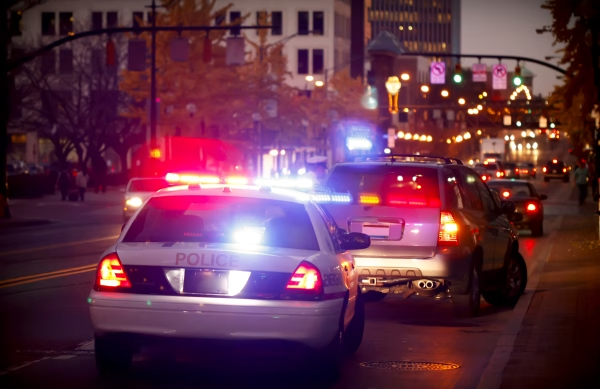
What Justifies a DUI Traffic Stop?
To pull someone over, police in the US must have a reasonable suspicion that a crime has occurred. At its simplest, this means they must have a justifiable reason to believe that someone in the car has broken the law. For DUI cases, this often means they witnessed the driver violating a traffic law, driving with a mechanical issue (like a broken tail light), committing another crime, or showing signs of impairment while driving, such as:
- Weaving or drifting.
- Driving too fast or too slow.
- Irregular breaking.
- Driving at night without headlights.
- Running a red light or a stop sign.
- Failing to yield the right of way properly.
- Driving on the wrong side of the road.
Reasonable Suspicion vs. Probable Cause
Reasonable suspicion is a valid basis for stopping a vehicle, but not for arresting someone or searching their vehicle. Instead, an officer must have probable cause for those actions. Here’s how probable cause and reasonable suspicion differ:
| Distinction | Reasonable Suspicion | Probable Cause |
|---|---|---|
| Required to: |
|
|
| Legal Standard: | An objective belief that a suspect broke the law based on observed facts | A strong belief that someone committed a crime based on available evidence |
| Duration: | Allows for a short detainment to issue a traffic ticket or develop probable cause | Justifies longer detainment, including arrest and, sometimes, confinement in jail |
| Examples: | A car driving at night with only fog lights on, weaving between lane markers, would provide reasonable suspicion of DUI | A driver with slurred speech patterns and red eyes says he just left a party after drinking a few beers |
When Is a DUI Stop Illegal?
“I am often able to challenge my client’s traffic stops successfully when officers lacked reasonable suspicion to make the stop or because they lacked probable cause to do anything more than issue a ticket,” says attorney Liss.
In cases lacking reasonable suspicion, this could be because the officer:
- Made a stop without an observable traffic violation.
- Based a stop on racial profiling.
- Didn’t corroborate information from an anonymous 9-11 call.
When probable cause is the issue, it could be by an officer:
- Performing DUI tests without justification.
- Detaining someone for longer than necessary without cause.
- Using a pretext stop as justification to search a vehicle.
- Calling for a drug dog or DRE without evidence of drug use.
- Searching a vehicle without cause or consent.
- Arresting someone for DUI without evidence of intoxicated driving.
Other reasons that stop may be considered unlawful include officers:
- Using excessive force.
- Making unwarranted intimidation or threats.
- Continuing questioning after a driver invokes their right to silence.
- Attempting to administer DUI tests without reading the required implied consent warning.
“Courts evaluate all of the circumstances involved in a traffic stop when determining whether it was lawful, and some factors are more consequential than others,” says Liss. For example, detaining a suspect for 20 minutes while the officer waits for a DRE would probably not be illegal, but keeping them there for two hours while continually asking them questions to learn more about whether they use drugs might be.
Is Reasonable Suspicion Required at a Checkpoint?
While stops at DUI checkpoints are not based on reasonable suspicion, they must comply with specific rules to be legal. Critically, drivers at checkpoints must be stopped according to a predetermined pattern, and officers cannot stop anyone outside the pattern.
To send a driver to secondary screening for DUI testing or vehicle searches, an officer must still establish probable cause during the initial interaction with the driver.
Learn more about laws on DUI checkpoints here.
What Happens If the Stop Was Unlawful?
When a driver’s rights were violated during a DUI traffic stop, their attorney will typically file a motion to suppress the evidence. If the motion is successful, the judge may exclude any evidence obtained as a result of the unlawful activity, including:
- Breathalyzer results.
- Blood test results.
- Field sobriety test results.
- Vehicle searches.
If there is too little evidence after the evidence is suppressed, the case could be dismissed entirely.
“Unfortunately, it is very rare for judges in San Diego to suppress cornerstone evidence, like chemical DUI tests,” explains Liss. Even so, these motions can lay the groundwork for a winning plea bargain. “If I can bring enough doubt to the legitimacy of the blood or breath test,” says Liss, “this may provide enough leverage to get the charges pleaded down to wet reckless —even if the driver’s BAC was far over the legal limit.”
For more information, visit our dedicated page on DUI defenses.
Common Police Mistakes During DUI Stops
Everyone makes mistakes, including police officers involved in DUI arrests, but when an officer makes a mistake, it can directly impact someone else’s entire future. Common slipups attorneys see in DUI cases include officers:
- Making traffic stops without reasonable suspicion.
- Performing DUI tests without probable cause.
- Detaining suspects without probable cause.
- Performing field sobriety tests incorrectly.
- Requesting a chemical test before placing the suspect under arrest.
- Neglecting to warn drivers about the consequences of refusing a DUI test.
- Failing to properly observe suspects before administering a Breathalyzer.
- Improperly administering the breath test.
- Taking a forced blood sample without a warrant.
- Writing a police report that is contradicted by their bodycam.
Can a DUI Be Dismissed Because of an Illegal Stop?
Yes, but it is rare for San Diego judges to suppress key evidence, such as chemical tests, let alone dismiss the charges. Typically, judges will dismiss charges only if there are grave procedural or civil rights violations that go beyond simple errors.
What to Do During a DUI Traffic Stop
“Most people want to get back on the road as soon as possible after being stopped by an officer,” explains attorney Peter Liss. “However, if you were drinking or have taken any kind of drug, including prescription medications, it is more important to protect your rights.” Here’s what to do if you see flashing lights and worry you could be charged with DUI:
- Pull over as soon as you find a safe place to stop.
- Do not exit the vehicle unless you are asked to.
- Stay silent and only answer questions about your identity, not where you are traveling to or from.
- Provide your license, proof of insurance, and registration.
- Never agree to take a field sobriety test.
- If you are over 21 and are not on probation, refuse to take a portable alcohol screening (PAS) test.
- Agree to take a breath or blood test if you have been placed under arrest.
- Document everything you remember about the stop, the arrest, and the DUI tests after you are released.
While this list may help you in future situations, its ok if you didn’t handle things perfectly. It’s never too late to challenge the stop with the help of a skilled attorney.
How a DUI Lawyer Evaluates a Traffic Stop
If you have been questioning, “Was my DUI stop legal?” talk to an attorney immediately. DUI law is complex, and it takes an experienced eye to determine whether an officer violated procedure. Fortunately, Peter Liss has over 40 years of experience representing clients in similar situations.
After hearing your side of events, he can review the evidence against you, which may include:
- The police report
- Police bodycam
- Dashcam footage
- Dispatch logs
- Witness testimony
- And more
If he finds any evidence that the police lacked reasonable suspicion or probable cause, or that they violated your rights in any other way, he can file motions to support your case.
When you have been accused of a DUI, call attorney Liss as soon as possible to start building your defense. You can schedule a free initial consultation by calling (760) 643-4050.
Frequently Asked Questions About DUI Traffic Stops
What is Reasonable Suspicion in a California DUI Case?
Reasonable suspicion means that an officer had an objective, justifiable reason to think you may have committed a crime. While they do not need to have evidence of wrongdoing, their opinion must be based on facts, not just a hunch.
Can Police Stop You Just to Check if You’re Drunk?
No, not if they have no reason to believe you are driving under the influence. If they have a reasonable suspicion based on your driving patterns, though, they can pull you over even if you have not committed a traffic violation.
Is Weaving Enough to Justify a DUI Stop?
It can be, especially when combined with other indications of drunk driving. In fact, weaving is one of the most common actions officers use to justify reasonable suspicion to stop a driver.
Can an Anonymous Tip Lead to a DUI Arrest?
Yes. However, officers must typically corroborate this information.
Was My DUI Stop Legal?
DUI case law is highly technical, so unless you were subject to a blatant rights violation, the only way to answer that question is to speak with a knowledgeable defense attorney.


